★★★★★★★★★★ (7/10)
If I were to describe this book quickly, I would have to say that it's perfectly adorable. Harrison takes a person from Jane Austen's history and creates a whole new view of life in the late 1800s. Many people who enjoy Austen's novels have some idea of what her life was like growing up, but I've rarely seen anyone take someone in Jane Austen's life and breathe a bit of creativity into that person. I Was Jane Austen's Best Friend was a delightful change, regardless of its fictitious nature, and I thoroughly intend to read it again.
This novel follows the diary of Jenny Cooper, a cousin of Jane's who spent a good deal of time with Jane's family. It begins with Jane being very sick, and Jenny deciding to do a deed of great daring, that would get her into an immense amount of trouble were she caught. The two girls are currently in a boarding school, run by a woman more interested in profit that her charges' health, well-being, or education. Jenny decides to send a letter to Jane's mother, which has been forbidden by the school mistress, so she must do this in the dead of night. It is this act of courage (for it would be disastrous to her reputation if she were seen at midnight on the streets without a chaperone), which both earns her the gratitude of the Austen family, and their protection, as well as introduces her to Captain Thomas Williams, who is very important later in the novel.
The Austens go to the school, where they find that Jenny has also taken ill, and bring both girls back to their home in Steventon. For the first time since Jenny's mother died, she is happy and enjoying her life and her schoolwork in the company of the Austen family, and all of the adventures that it entails.
So much for the plot. (I feel that saying much more would ruin the effect of the novel if you decide to read it.)
What I like most about I Was Jane Austen's Best Friend is that Harrison manages to use the details of Austen's life without making the entire novel about Jane. I'm always a bit wary about reading books written about people related to or who were friends of famous personages; there's always a chance that the famous person (i.e. Austen) will become the focus of the book, which defeats the whole purpose. In this novel, Jane happily subsides into the role of supporting character, while Jenny takes the spotlight. I am more interested in Jenny's life than Jane's, although the way Harrison incorporates events in Austen's life does make for interesting reading. I read Jenny's diary entries because I want to know what has happened to her that day, or that week, not because I want to find out what Jane said or did or thought.
Harrison did do one thing that is extremely important: she gave the two girls the bond of authorship -- Jane and her novel bits and Jenny and her detailed diary. While there could be any number of things that could make these two the best of friends, I think Harrison's choice of writing is the most apt. They share many moments in the novel where they just sit in their room writing, then sharing their ideas. It's also kind of funny when Harrison creates events that give Jane or Jenny ideas that are parts of Austen's books (which we know and love).
At the same time though, I was surprised to see how differently the two girls are portrayed. I've always thought of Austen as a woman who never fit into the societal norms, but not exactly to the extent she appears in the novel. She seems to flout propriety at every turn, and there are some instances were I am a bit embarrassed for her. Jenny, on the other hand, is more concerned about growing up to be a well-bred young lady. Given that she has nearly no dowry, no great connections, and a brother and sister-in-law who rather wished Jenny didn't exist, Jenny's life seemingly depends on her making a suitable marriage. Jenny is also a bit more interested in domestic life. She does enjoy the various adventures she gets into with Jane, but she also wants to excel at her "accomplishments" (she draws very well), learn what it takes to run a household, and she thinks more about her future. When I think about these girls side by side, Jenny's image is of a young woman who is a bit shy, but well-mannered and polite, while Jane's image brings to mind a village urchin just waiting to find a mud puddle, but who has the wit and intelligence of a genius. Two drastic images, but when the two are put in the same novel, they balance each other nicely.
All in all, I Was Jane Austen's Best Friend left me feeling quite happy, and I thoroughly enjoyed the brief glimpse into Jenny Cooper's life (that's not her real name though...). Harrison is quite a talented writer, and I hope to find more books from her in the future. There was such a good deal of vivid images and character depth, which I feel is a mark of a great author, as well as a great book, that I would recommend this novel to anyone who enjoys a good romp in history and girlhood.
Wednesday, November 9, 2011
The Little Giant of Aberdeen County - Tiffany Baker
★★★★★★★★★★ (0/10) for not being able to finish
I feel sad. This is quite possibly the first time I've even given up on a book. Usually, I will read to the end just to be done with a book, no matter how much I don't like it. With this novel, though, I've been stuck on page 37 for over 3 weeks. I can't go on like this, so I am officially quitting on this book. It will retire peacefully to a dusty corner of my bookshelf, and live the rest of its life wondering why it has no friends.
I don't feel that there's anything else I can say. I didn't read enough of it. Thank goodness for Borders closing; I don't feel so bad spending money of this novel since it was 75% off.
Wednesday, October 26, 2011
Mr. Knightley's Diary - Amanda Grange
★★★★★★★★★★ (9/10)
Continuing in the same vein as the last post, I return to Amanda Grange and her wonderful diaries of the men in Jane Austen's novels. This time around we come to Mr. Knightley - the down-to-earth, upstanding gentleman-hero of Emma. He's one of my favorite male characters, and not just from Austen novels, so I may be a bit biased when it comes to my feelings for this novel. However, I do think that Grange did another fantastic job entering the mind of Mr. Knightley; she kept to the original novel, but gave the reader a look into Mr. Knightley's deeper feelings, hopes, and fears.
I've always felt that Mr. Knightley was one of the more difficult characters to understand in Emma. On the surface, he is very settled in his ways, has a fulfilling life, and enjoys the company of the Woodhouses, but never seems to have any inclination to become more a part of the family than a true friend. Since Emma was born, Mr. Knightley acted more like a brother and role model for her, and was the only person who would tell Emma when she was in the wrong. In this respect, he was highly influential to Emma's personal character, and continued to be a check on her own behavior.
Getting into Mr. Knightley's Diary, I feel that Grange really comprehended the difficulties and confusions that Mr. Knightley faced. As Emma grew up, his feelings naturally changed, but not in a way anyone could have expected. His conversations with Mrs. Weston about Emma seemed to sway back and forth between warm admiration of Emma as a person and criticism of her actions. Even in his private thoughts, thanks to Grange, Mr. Knightley is not quite sure what to make of his emotions. His is one of the most heart-wrenching struggles to read about because he constantly tries to convince himself that he should explain his feelings, then persuades himself that he should never say a word. Emma is no help to him, either. She is witty and friendly, but her age and situation in life lead her to have no cares for the type of relationship that Mr. Knightley envisions. It also does not bode well that there is such a gap in their ages, or that their siblings (his brother and her sister) are already married to each other. I still think it's strange for a person to marry someone their already related to by marriage (i.e. Emma marrying her sister's husband's brother).
Regardless of my own feelings about the nature of the match, I am still intrigued by Mr. Knightley as a character. In Emma, I believed him to be a strong person, greatly enmeshed in helping those around him, and dedicated to seeing to his own business personally instead of foisting it off on an underling. In Grange's diary for him, I see these qualities again, but there is something else about him that makes him more endearing. I get a sense of gentleness, compassion, understanding, and great forbearance towards nearly everyone. While these may or may not be implied in Austen's novel, I feel that all of these qualities are necessary in order to understand his feelings, misgivings, and foibles in his own mind.
I especially liked the conversations between Emma and him after they become engaged, and I felt so much pity for him because of Emma's flakiness. In Austen's novel, there is a debate over what to do about Mr. Woodhouse, as he wouldn't be able to bear being alone at Hartfield if Emma married. Still, what Grange portrayed made Emma's character even worse than my original opinion of Emma made her out to be. She changes her mind multiple times each day about whether or not she should marry Mr. Knightley. She knows that she loves him, but she cannot bring herself to be decisive. Mr. Knightley is constantly in mental agony from her wavering behavior; I'm in agony over her behavior! It feels like it takes weeks for Emma to accept and propose Mr. Knightley's solution that they all live at Hartfield until Mr. Woodhouse passes away. The fact that it took so long for Emma to believe it would work is astounding, and I think that Grange captures Emma's selfishness and inconstancy with this episode.
As usual, another highly engaging novel by Grange that leaves me waiting to read another one of her "diaries." I give Mr. Knightley's Diary full marks for creativity because there was a good deal that Grange would have had to imagine (such as Knightley's conversations with his steward, among other things), and I appreciate Grange's devotion to not changing the original storyline. But, it is that time again, so -- on to the next novel!
I especially liked the conversations between Emma and him after they become engaged, and I felt so much pity for him because of Emma's flakiness. In Austen's novel, there is a debate over what to do about Mr. Woodhouse, as he wouldn't be able to bear being alone at Hartfield if Emma married. Still, what Grange portrayed made Emma's character even worse than my original opinion of Emma made her out to be. She changes her mind multiple times each day about whether or not she should marry Mr. Knightley. She knows that she loves him, but she cannot bring herself to be decisive. Mr. Knightley is constantly in mental agony from her wavering behavior; I'm in agony over her behavior! It feels like it takes weeks for Emma to accept and propose Mr. Knightley's solution that they all live at Hartfield until Mr. Woodhouse passes away. The fact that it took so long for Emma to believe it would work is astounding, and I think that Grange captures Emma's selfishness and inconstancy with this episode.
As usual, another highly engaging novel by Grange that leaves me waiting to read another one of her "diaries." I give Mr. Knightley's Diary full marks for creativity because there was a good deal that Grange would have had to imagine (such as Knightley's conversations with his steward, among other things), and I appreciate Grange's devotion to not changing the original storyline. But, it is that time again, so -- on to the next novel!
Tuesday, September 6, 2011
Captain Wentworth's Diary - Amanda Grange
★★★★★★★★★★ (9/10)
Here we are, once again, with a diary of one of Jane Austen's under-appreciated male characters. This time I went into the mind of Captain Wentworth, the estranged former suitor of Anne Elliot in Persuasion. Captain Wentworth's Diary was one I was especially eager to read, as Persuasion is probably my favorite Jane Austen novel. For the first time, I got to imagine what his own life was like, before he met Anne and to think about how Jane Austen would react to Grange's interpretation of Wentworth's adventures, follies, and hearbreak.
I started reading this novel with no real thoughts on Captain Wentworth's time before and after meeting Anne Elliot. I pitied him for most of Persuasion because of his shattered chance of happiness, and eight years of waiting and probably misery a lot of the time, but I hadn't given any thought to what kind of person he was before they had met and fallen in love. I usually imagined Wentworth as the dashing naval officer, with gentle manners and a hearty laugh, but I had not ascribed any personality to him. After reading CWD, I feel I was remiss and haven't given Wentworth the credit that he deserves.
So, with that, we begin CWD. I greatly appreciated that Grange started this novel a good deal before Wentworth's initial meeting with Anne, and their subsequent engagement. Grange has the reader meet him, as well as Benwick and Harville, just when Wentworth is promoted to Commander, and has won a large prize from sinking/disabling a French warship. Through his conversations and his own personal thoughts in the diary entries, I find that I agree with Grange when she makes him out to be a young, vibrant, easy-going man, who enjoys the world because he has found that his career is finally going somewhere, and he can afford to look forward to a promising future. During this portion of the novel, I finally got to meet the mysterious "Wentworth, the curate," Captain Wentworth's brother, who appears in name only in Persuasion. He's mentioned multiple times, but Austen never introduces him in person. I like Grange's take on the brothers' relationship as well. They are wholly different, yet have a strong bond, and each looks out for the other. Not only are their relationship and interactions interesting, but they pave the path for Wenthworth's meeting with Anne, which was a surprising meeting, yet satisfying, nonetheless.
I'm going to skip their meeting, engagement, un-engagement, and other bits that are easily inferred from reading Persuasion itself, and move on to Wentworth's reasoning behind flirting with the Misses Musgrove. I had originally thought that his attentions to Louisa and Henrietta stemmed partly from wanting to punish Anne, and partly from being a friendly human being. I didn't expect Grange to interpret his actions as an intention to marry one or the other of these girls. Thinking back to Persuasion, this conclusion makes sense: he is out of the navy and looking to marry, Louisa (who becomes a favorite) is young and pretty, and Wentworth has enough money to support himself and a wife. He also spends a good deal of time with both girls, and I can remember a few scenes where it seems as though Louisa is enough in love with him to expect a proposal. Whatever the case may be, whether Austen was encouraging Wentworth to fall in love with someone new, or if she just was using H & L to make Anne jealous, it doesn't truly matter. It's an aspect of the book that can be read either way, and I'm still making up my mind as to which way I believe.
Just as with the other diaries Grange has written, my favorite part of Wentworth's diary is seeing his reactions to scenes from Persuasion. I know what Anne is thinking, but having Grange's imagination bring to life Wentworth's thoughts, emotions, internal conflicts, hopes, and plans gives the whole story more depth and I get a better sense of enjoyment from combining the two in my mind. For instance, toward the end, Wentworth follows Anne to Bath with the hopes of talking to her about his own feelings, and to see if hers are still what they were eight years before. From Anne's perspective, his arrival is a welcome shock. She had believed him to be over her, and did not expect to see him in a place that she didn't think he particularly liked. However, Wentworth finds himself in Bath with his good intentions, only to find that Anne's attention is being comandeered by Mr. Elliot. What is he to think but that Anne's affections have changed, and she now prefers this man who is next in line for her father's title. Their situation was awkward enough in Persuasion because I could tell that Anne didn't know of Wentworth's assumptions, but to see Wentworth's reactions to Anne's conversations and actions toward Elliot, was more amusing and helped clarify a few things that used to puzzle me.
So, again, Grange has done a fantastically excellent job bringing one of may favorite characters into the limelight in his own right. Captain Wentworth now has a voice, and I like the words that Grange has put in his mouth. Captain Wentworth's Diary is a wonderful addition to Grange's other diaries of Austen's men, and I can't wait to read more of them!
Tuesday, July 26, 2011
Mistress of the Art of Death Novels - Ariana Franklin
★★★★★★★★★★ (10/10)
I have finally finished all four novels in this series, and I must say that each one is fantastic, and I wish there were more novels to follow. (There may be, but I don't know...) Ariana Franklin takes a period in history and delves into the superstitions, culture clashes, theories, prejudices, and assumptions that come with it. While going through all of this, Franklin presents a character that I couldn't help but care about, and I continued to like her in each new novel, each new adventure in her life. The Mistress of the Art of Death novels are an amazing mix of a smattering of historical events with wonderfully imaginative fiction, lovable characters, clever villains, and landscapes that take your breath away.
Mistress of the Art of Death
In this first novel, Franklin introduces Adelia, a doctor from a celebrated medical school in Salerno, who is forced to travel to England to solve a mystery for King Henry II. Adelia is a unique woman for her time. It's the 12th century, where men rule a woman from the day she is born, yet she is an independent person who has had the privilege to grow up in the tolerant city of Salerno. Nowhere else in Europe are women allowed to practice medicine, and not only is Adelia an intelligent woman, but she is the best student in the art of death (today she would be a forensic scientist with the skills of a surgeon) that Salerno has ever produced.
What got me hooked to this novel from the get-go was Adelia's way of thinking. She sees everything from an objective point of view because it's necessary if she is to do her job properly. She assumes everyone is a suspect until she can scientifically rule them out, and her impartiality is something I haven't really seen in a book before. Adelia is also not your typical 12th century female; she is graceless, unselfconscious, and brutally honest. In England, Adelia discovers the advantage of silence, prudence, and blending in, since she needs all three to solve the horrible crimes that have been plaguing Cambridge and King Henry.
This novel is both engrossing as well as a stepping stone to the other three novels in the series. Here, Adelia must find the person behind the mutilation and murder of four Cambridgeshire children before another one is harmed, but she must do this while giving the impression that her eunuch bodyguard, Mansur, is actually the doctor. During her time in this city, she makes friends who believe in her and her abilities, a lover who would defy the Church for her, a horrifically smelly dog, and the appreciation of a king who is using her for his own means without regard to her life or safety, all while discovering the monster than can live inside any human being.
The Serpent's Tale
Adelia is back, but this time, the trouble is closer to King Henry's heart. His favorite mistress, Rosamund Clifford has been murdered by poison, and he sends Adelia to discover who was behind it. Most of England believes that Henry's estranged wife Eleanor was behind it all, but if Adelia can, she must prove Eleanor innocent or risk another civil war that will tear the country apart. The difference is that this time, Adelia has a daughter. Her love affair since the end of the previous novel has given her the love of her infant daughter, Almeison (Allie for short).
Things get more complicated in this novel because in addition to Adelia's own safety, she must now look to the safety of her baby, and more often than not, she wants to put Allie's comfort, safety, and health above her own, and most definitely above her duty to King Henry, who is forcibly preventing her from returning home to Salerno. It's interesting to see Adelia's motivations change. She first came to England with a scientific interest and the hope to stop the slaying of innocent children, and now has started to like the country for its own merits, yet she still cannot forgive Henry for keeping her there against her wishes. There is more of an emotional struggle for Adelia here as well. She refused to marry Allie's father, thinking that marriage would mean she would have to become someone else; it would mean that she would have to give up her profession, which was something she couldn't bear to part with. During this whole novel, I can see Adelia's battle between her love for the man, and her hatred towards him for putting too obstacles between them.
The mystery in this one is also a little more complex. There are two murders, seemingly unconnected, that need to be solved, and Adelia has to deal with mercenaries who have the abbey where she is staying under a lockdown, an insane housekeeper who wishes to kill anyone associated with Rosamund's death, and a girl who is about to be married against her will, among other things. Luckily she has all of her close friends on the journey with her, so she does not have to do all of this alone. Still, she has to trust that Henry will save the day, and listen to her report about what actually went on.
Grave Goods
This is probably my favorite of the novels because it covers more than just history. Franklin incorporates a deeply rooted legend into this novel of mystery, murder, abduction, and a deplorable English winter. In this novel, Adelia is sent to Glastonbury to see whether a newly unearthed coffin contains the remains of King Arthur and Guinevere. King Henry is hopeful that if he can convince the Welsh rebels that Arthur is truly dead, they would be more willing to negotiate with him and stop all of the fighting. Once again, Adelia, Mansur, Allie, and their friend Gyltha are on the case, while accompanying Emma, Lady Wolvercote (who we met in the previous novel) to one of her estates.
I think that this novel is too good to summarize, and anything I say won't really do it justice. I'd rather that you read it to see what kind of marvels Franklin can unravel for you while trying to keep Adelia and her friends alive.
A Murderous Procession
Here we have another assignment for Adelia that will take her home to Salerno, though she won't be allowed to stay. Henry has sent for Adelia so that she can, under the guise of being Mansur's assistant again, accompany Henry's daughter, Princess Joanna, on her trip to Palermo, where she will be married to William, King of Sicily. He doesn't trust Joanna's private physician, Dr. Arnulf, to keep to healthy, and wants Adelia to be there to use scientific medicine, and not just the home remedy crap that Arnulf would prescribe. The worst part for Adelia is that Henry is holding her daughter hostage to ensure her return to England. Allie has been put in the care of the "imprisoned" Queen Eleanor, where she'll be taken care of until Adelia returns from a trip that may last a year or more.
What Adelia doesn't realize is that one of the members of the gigantic party going with Joanna is a man who wants her dead more than he wants anything else in the world. Adelia accidentally killed his life mate, and this man wants revenge, which will only be satisfied with Adelia's own death. "Accidental deaths" follow Adelia at every turn, where superstitious people, including some of the high clergy, start accusing her of being a witch, that if they prove it, could mean she would be burned at the stake. Oddly enough, that is a fate that she narrowly escapes, but for an entirely different reason. First, her horse dies, and people blame her for wishing its death after the horse made if difficult for her to dismount the day before. Then, a high ranking member of the envoy dies, and Adelia is blamed because someone said she cursed him for assaulting her maid. Then, the head laundress is found drowned a laundry vat, and, again, Adelia is accused of contriving her death because they'd had a quarrel earlier. Circumstances keep cropping up where the party's logical choice to blame things on is Adelia: she is a foreigner, a woman, and a loose woman as far as they're concerned, and keeping company with a Saracen doctor doesn't help her any either. She must trust what friends she can, as well as the Princess, to make it through the journey, and live long enough to get back to Allie. Exciting or what?
I gave these novels 10/10 stars because that are astonishingly well-crafted, and the characters are so unique and believable, that I wish I could know them for myself. Ariana Franklin is an excellent author, and I can only hope that she finds it meet to continue writing novels of her little Mistress of the Art of Death.
I have finally finished all four novels in this series, and I must say that each one is fantastic, and I wish there were more novels to follow. (There may be, but I don't know...) Ariana Franklin takes a period in history and delves into the superstitions, culture clashes, theories, prejudices, and assumptions that come with it. While going through all of this, Franklin presents a character that I couldn't help but care about, and I continued to like her in each new novel, each new adventure in her life. The Mistress of the Art of Death novels are an amazing mix of a smattering of historical events with wonderfully imaginative fiction, lovable characters, clever villains, and landscapes that take your breath away.
Mistress of the Art of Death
In this first novel, Franklin introduces Adelia, a doctor from a celebrated medical school in Salerno, who is forced to travel to England to solve a mystery for King Henry II. Adelia is a unique woman for her time. It's the 12th century, where men rule a woman from the day she is born, yet she is an independent person who has had the privilege to grow up in the tolerant city of Salerno. Nowhere else in Europe are women allowed to practice medicine, and not only is Adelia an intelligent woman, but she is the best student in the art of death (today she would be a forensic scientist with the skills of a surgeon) that Salerno has ever produced.
What got me hooked to this novel from the get-go was Adelia's way of thinking. She sees everything from an objective point of view because it's necessary if she is to do her job properly. She assumes everyone is a suspect until she can scientifically rule them out, and her impartiality is something I haven't really seen in a book before. Adelia is also not your typical 12th century female; she is graceless, unselfconscious, and brutally honest. In England, Adelia discovers the advantage of silence, prudence, and blending in, since she needs all three to solve the horrible crimes that have been plaguing Cambridge and King Henry.
This novel is both engrossing as well as a stepping stone to the other three novels in the series. Here, Adelia must find the person behind the mutilation and murder of four Cambridgeshire children before another one is harmed, but she must do this while giving the impression that her eunuch bodyguard, Mansur, is actually the doctor. During her time in this city, she makes friends who believe in her and her abilities, a lover who would defy the Church for her, a horrifically smelly dog, and the appreciation of a king who is using her for his own means without regard to her life or safety, all while discovering the monster than can live inside any human being.
The Serpent's Tale
Adelia is back, but this time, the trouble is closer to King Henry's heart. His favorite mistress, Rosamund Clifford has been murdered by poison, and he sends Adelia to discover who was behind it. Most of England believes that Henry's estranged wife Eleanor was behind it all, but if Adelia can, she must prove Eleanor innocent or risk another civil war that will tear the country apart. The difference is that this time, Adelia has a daughter. Her love affair since the end of the previous novel has given her the love of her infant daughter, Almeison (Allie for short).
Things get more complicated in this novel because in addition to Adelia's own safety, she must now look to the safety of her baby, and more often than not, she wants to put Allie's comfort, safety, and health above her own, and most definitely above her duty to King Henry, who is forcibly preventing her from returning home to Salerno. It's interesting to see Adelia's motivations change. She first came to England with a scientific interest and the hope to stop the slaying of innocent children, and now has started to like the country for its own merits, yet she still cannot forgive Henry for keeping her there against her wishes. There is more of an emotional struggle for Adelia here as well. She refused to marry Allie's father, thinking that marriage would mean she would have to become someone else; it would mean that she would have to give up her profession, which was something she couldn't bear to part with. During this whole novel, I can see Adelia's battle between her love for the man, and her hatred towards him for putting too obstacles between them.
The mystery in this one is also a little more complex. There are two murders, seemingly unconnected, that need to be solved, and Adelia has to deal with mercenaries who have the abbey where she is staying under a lockdown, an insane housekeeper who wishes to kill anyone associated with Rosamund's death, and a girl who is about to be married against her will, among other things. Luckily she has all of her close friends on the journey with her, so she does not have to do all of this alone. Still, she has to trust that Henry will save the day, and listen to her report about what actually went on.
Grave Goods
This is probably my favorite of the novels because it covers more than just history. Franklin incorporates a deeply rooted legend into this novel of mystery, murder, abduction, and a deplorable English winter. In this novel, Adelia is sent to Glastonbury to see whether a newly unearthed coffin contains the remains of King Arthur and Guinevere. King Henry is hopeful that if he can convince the Welsh rebels that Arthur is truly dead, they would be more willing to negotiate with him and stop all of the fighting. Once again, Adelia, Mansur, Allie, and their friend Gyltha are on the case, while accompanying Emma, Lady Wolvercote (who we met in the previous novel) to one of her estates.
I think that this novel is too good to summarize, and anything I say won't really do it justice. I'd rather that you read it to see what kind of marvels Franklin can unravel for you while trying to keep Adelia and her friends alive.
A Murderous Procession
Here we have another assignment for Adelia that will take her home to Salerno, though she won't be allowed to stay. Henry has sent for Adelia so that she can, under the guise of being Mansur's assistant again, accompany Henry's daughter, Princess Joanna, on her trip to Palermo, where she will be married to William, King of Sicily. He doesn't trust Joanna's private physician, Dr. Arnulf, to keep to healthy, and wants Adelia to be there to use scientific medicine, and not just the home remedy crap that Arnulf would prescribe. The worst part for Adelia is that Henry is holding her daughter hostage to ensure her return to England. Allie has been put in the care of the "imprisoned" Queen Eleanor, where she'll be taken care of until Adelia returns from a trip that may last a year or more.
What Adelia doesn't realize is that one of the members of the gigantic party going with Joanna is a man who wants her dead more than he wants anything else in the world. Adelia accidentally killed his life mate, and this man wants revenge, which will only be satisfied with Adelia's own death. "Accidental deaths" follow Adelia at every turn, where superstitious people, including some of the high clergy, start accusing her of being a witch, that if they prove it, could mean she would be burned at the stake. Oddly enough, that is a fate that she narrowly escapes, but for an entirely different reason. First, her horse dies, and people blame her for wishing its death after the horse made if difficult for her to dismount the day before. Then, a high ranking member of the envoy dies, and Adelia is blamed because someone said she cursed him for assaulting her maid. Then, the head laundress is found drowned a laundry vat, and, again, Adelia is accused of contriving her death because they'd had a quarrel earlier. Circumstances keep cropping up where the party's logical choice to blame things on is Adelia: she is a foreigner, a woman, and a loose woman as far as they're concerned, and keeping company with a Saracen doctor doesn't help her any either. She must trust what friends she can, as well as the Princess, to make it through the journey, and live long enough to get back to Allie. Exciting or what?
I gave these novels 10/10 stars because that are astonishingly well-crafted, and the characters are so unique and believable, that I wish I could know them for myself. Ariana Franklin is an excellent author, and I can only hope that she finds it meet to continue writing novels of her little Mistress of the Art of Death.
Friday, June 24, 2011
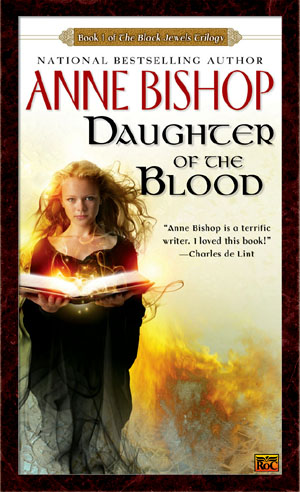
Daughter of the Blood - Anne Bishop
★★★★★★★★★★ (10/10)
This book is awesome! I think that's enough to say about it, but I'll write more just because I loved it so much! Anne Bishop may just be my new favorite author if the rest of this series is even half as good as Daughter of the Blood. There is a combination of magic, mystery, intrigue, and ambitious courage in this novel that kept me reading, and made me anxious to read the other novels in this series (I know that there are at least 7 altogether).
Daughter of the Blood is a book that changes perspective multiple times in each chapter, but the characters are so intertwined that it just makes the plot more interesting. The main people of note are Saetan, Daemon, Jaenelle, Surreal, and Lucivar. Jaenelle is the real star of the story. She is the girl that the rest of the main characters have been waiting for for 700 years. Jaenelle is Witch; she is the most powerful person in Terreille, and will grow up to rule the entire realm, which is currently run by a corrupt priestess bent on world domination. Unfortunately, Jaenelle is still just a young girl. She has not grown into her power, and she is subject to the horrors inflicted on her because her family thinks that she is mentally or emotionally disturbed. Saetan and Daemon and determined to keep her safe because, without her, the world will basically destroy itself.
Daemon is possibly my favorite character just because of how twisted he is. He is Saetan's biological son, but grew up not knowing who his true parents were. He assumed that he'd been abandoned by his father to grow up as a bastard to a mother who didn't care about him. Because of the society of Terreille, Daemon's illegitimacy denied him any social status, despite his innate power, and he is put into slavery. The interesting this about this society is that it is entirely matriarchal; men have little if any political power, and are meant to serve the women in charge. Makes me feel a little bad that the men have no other option, but it's a nice change that women are in power for once. But back to Daemon. Due to his ill treatment by the corrupt priestess, Dorothea, Daemon has a deep hatred of all women. The power he possesses from his Black Jewels (I'm not even going to try to explain that, it'll take too long) means that if he loses his temper, he could level an entire city. Whenever a queen he's been sent to serve angers him, she tends to end up dead, or worse. Yet, he has a soft spot for Jaenelle and her sister, Wilhelmina, as well as a select few other women who have been kind to him over the years. I feel that, if I were his therapist, I would go insane myself trying to sort out the inner workings of Daemon's mind. There are dark secrets that don't come out in this novel, but I'm sure that there are complicated reasons behind the way he behaves.
I don't want to go into deep detail about every major character, so I'll stop with those two. I think that if I talk about anyone else, I'll be giving too much of the plot away, so I'll move away from character description. :)
The novel itself is so easy to fall into. There are a lot of things that need to be explained to the reader about the society and the history of its people, but Bishop does this so smoothly and cleanly, without interrupting the plot line, that I hardly noticed when I learned a new tidbit of necessary information about this world. It's obvious that Bishop put a lot of thought into how the three Realms interact (or don't interact) and what Terreille was like before the overarching corruption took over the Blood. Every new detail Bishop introduces about the people of this world blends in with what she's already told you, and I enjoy the fact that I found no contradictions that have a habit of happening in novels like Daughter of the Blood. Kudos to Bishop for taking so much care in the building of this world, and the characters in it!
I'm going to stop there before I just start recounting the entire plot and leave you with no reason to read it for yourself. I am in love with this series and this author already, and I have already borrowed the next two novels from the library, so it's only a matter of time before I get to find out what happens next. They will not be the next book on my reading list, but they'll be close. Please read books by Anne Bishop. She is a fantastic author, whose writing style can't fail to pull you into the novels that she writes. So exciting!
This book is awesome! I think that's enough to say about it, but I'll write more just because I loved it so much! Anne Bishop may just be my new favorite author if the rest of this series is even half as good as Daughter of the Blood. There is a combination of magic, mystery, intrigue, and ambitious courage in this novel that kept me reading, and made me anxious to read the other novels in this series (I know that there are at least 7 altogether).
Daughter of the Blood is a book that changes perspective multiple times in each chapter, but the characters are so intertwined that it just makes the plot more interesting. The main people of note are Saetan, Daemon, Jaenelle, Surreal, and Lucivar. Jaenelle is the real star of the story. She is the girl that the rest of the main characters have been waiting for for 700 years. Jaenelle is Witch; she is the most powerful person in Terreille, and will grow up to rule the entire realm, which is currently run by a corrupt priestess bent on world domination. Unfortunately, Jaenelle is still just a young girl. She has not grown into her power, and she is subject to the horrors inflicted on her because her family thinks that she is mentally or emotionally disturbed. Saetan and Daemon and determined to keep her safe because, without her, the world will basically destroy itself.
Daemon is possibly my favorite character just because of how twisted he is. He is Saetan's biological son, but grew up not knowing who his true parents were. He assumed that he'd been abandoned by his father to grow up as a bastard to a mother who didn't care about him. Because of the society of Terreille, Daemon's illegitimacy denied him any social status, despite his innate power, and he is put into slavery. The interesting this about this society is that it is entirely matriarchal; men have little if any political power, and are meant to serve the women in charge. Makes me feel a little bad that the men have no other option, but it's a nice change that women are in power for once. But back to Daemon. Due to his ill treatment by the corrupt priestess, Dorothea, Daemon has a deep hatred of all women. The power he possesses from his Black Jewels (I'm not even going to try to explain that, it'll take too long) means that if he loses his temper, he could level an entire city. Whenever a queen he's been sent to serve angers him, she tends to end up dead, or worse. Yet, he has a soft spot for Jaenelle and her sister, Wilhelmina, as well as a select few other women who have been kind to him over the years. I feel that, if I were his therapist, I would go insane myself trying to sort out the inner workings of Daemon's mind. There are dark secrets that don't come out in this novel, but I'm sure that there are complicated reasons behind the way he behaves.
I don't want to go into deep detail about every major character, so I'll stop with those two. I think that if I talk about anyone else, I'll be giving too much of the plot away, so I'll move away from character description. :)
The novel itself is so easy to fall into. There are a lot of things that need to be explained to the reader about the society and the history of its people, but Bishop does this so smoothly and cleanly, without interrupting the plot line, that I hardly noticed when I learned a new tidbit of necessary information about this world. It's obvious that Bishop put a lot of thought into how the three Realms interact (or don't interact) and what Terreille was like before the overarching corruption took over the Blood. Every new detail Bishop introduces about the people of this world blends in with what she's already told you, and I enjoy the fact that I found no contradictions that have a habit of happening in novels like Daughter of the Blood. Kudos to Bishop for taking so much care in the building of this world, and the characters in it!
I'm going to stop there before I just start recounting the entire plot and leave you with no reason to read it for yourself. I am in love with this series and this author already, and I have already borrowed the next two novels from the library, so it's only a matter of time before I get to find out what happens next. They will not be the next book on my reading list, but they'll be close. Please read books by Anne Bishop. She is a fantastic author, whose writing style can't fail to pull you into the novels that she writes. So exciting!
Friday, June 17, 2011
The Montefeltro Conspiracy - Marcello Simonetta
★★★★★★★★★★ (4/10)
So this is why I don't usually read non-fiction. It takes way too long to get through, and half of the time, I'm not really interested in what the author is talking about. That was the case in The Montefeltro Conspiracy. When I purchased this book (for a whopping $1.00), I initially thought it was a work of fiction based on the jacket description and the cover art. Little did I know that 211 pages of research and a grueling week of reading awaited me. While this book may be a gripping read for someone doing post-doctoral research on Italian Renaissance politics, it was not interesting for a casual reader hoping to be a part of the discovery of a dastardly plot.
I almost think that it's needless to say that summarizing this book is impossible. Simonetta includes so many details (which are useful) and covers so many events and situations that I would have to write 30 pages to summarize the conspiracy he uncovered. This being the case, I'm just going to gloss over the summary in a few sentences.
There was a conspiracy to kill Lorenzo de' Medici (The Magnificent) that has been historically proved, but Simonetta discovered (from letters in a family archive?) that the structure of this conspiracy was developed and masterminded in part by the Duke of Urbino, Federico de Montefeltro (thus the title). Simonetta covers a period of around six years, where he explains the plots, letters, wars, political tricks, and money exchanges that took place to bring about the conspiracy as well as its aftermath. By the end of the novel, everyone is dead, and life moves on for the rest of Italy.
I liked all of the art included as visual aids, but I think that was about it.
So, this is a warning to me to not read non-fiction unless I have to. Things like biographies or something may not be too bad, but The Montefeltro Conspiracy was much too involved for the type of reading that I like to do. I don't want to talk about this book anymore. :(
So this is why I don't usually read non-fiction. It takes way too long to get through, and half of the time, I'm not really interested in what the author is talking about. That was the case in The Montefeltro Conspiracy. When I purchased this book (for a whopping $1.00), I initially thought it was a work of fiction based on the jacket description and the cover art. Little did I know that 211 pages of research and a grueling week of reading awaited me. While this book may be a gripping read for someone doing post-doctoral research on Italian Renaissance politics, it was not interesting for a casual reader hoping to be a part of the discovery of a dastardly plot.
I almost think that it's needless to say that summarizing this book is impossible. Simonetta includes so many details (which are useful) and covers so many events and situations that I would have to write 30 pages to summarize the conspiracy he uncovered. This being the case, I'm just going to gloss over the summary in a few sentences.
There was a conspiracy to kill Lorenzo de' Medici (The Magnificent) that has been historically proved, but Simonetta discovered (from letters in a family archive?) that the structure of this conspiracy was developed and masterminded in part by the Duke of Urbino, Federico de Montefeltro (thus the title). Simonetta covers a period of around six years, where he explains the plots, letters, wars, political tricks, and money exchanges that took place to bring about the conspiracy as well as its aftermath. By the end of the novel, everyone is dead, and life moves on for the rest of Italy.
I liked all of the art included as visual aids, but I think that was about it.
So, this is a warning to me to not read non-fiction unless I have to. Things like biographies or something may not be too bad, but The Montefeltro Conspiracy was much too involved for the type of reading that I like to do. I don't want to talk about this book anymore. :(
Subscribe to:
Posts (Atom)