skip to main |
skip to sidebar
★★★★★★★★★★ (10/10)
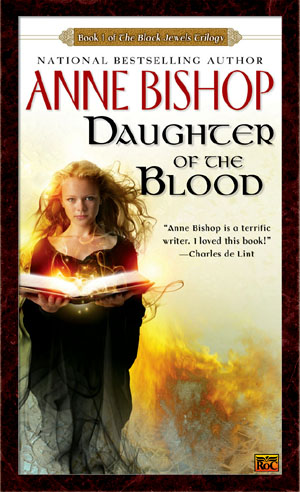
This book is awesome! I think that's enough to say about it, but I'll write more just because I loved it so much! Anne Bishop may just be my new favorite author if the rest of this series is even half as good as Daughter of the Blood. There is a combination of magic, mystery, intrigue, and ambitious courage in this novel that kept me reading, and made me anxious to read the other novels in this series (I know that there are at least 7 altogether).
Daughter of the Blood is a book that changes perspective multiple times in each chapter, but the characters are so intertwined that it just makes the plot more interesting. The main people of note are Saetan, Daemon, Jaenelle, Surreal, and Lucivar. Jaenelle is the real star of the story. She is the girl that the rest of the main characters have been waiting for for 700 years. Jaenelle is Witch; she is the most powerful person in Terreille, and will grow up to rule the entire realm, which is currently run by a corrupt priestess bent on world domination. Unfortunately, Jaenelle is still just a young girl. She has not grown into her power, and she is subject to the horrors inflicted on her because her family thinks that she is mentally or emotionally disturbed. Saetan and Daemon and determined to keep her safe because, without her, the world will basically destroy itself.
Daemon is possibly my favorite character just because of how twisted he is. He is Saetan's biological son, but grew up not knowing who his true parents were. He assumed that he'd been abandoned by his father to grow up as a bastard to a mother who didn't care about him. Because of the society of Terreille, Daemon's illegitimacy denied him any social status, despite his innate power, and he is put into slavery. The interesting this about this society is that it is entirely matriarchal; men have little if any political power, and are meant to serve the women in charge. Makes me feel a little bad that the men have no other option, but it's a nice change that women are in power for once. But back to Daemon. Due to his ill treatment by the corrupt priestess, Dorothea, Daemon has a deep hatred of all women. The power he possesses from his Black Jewels (I'm not even going to try to explain that, it'll take too long) means that if he loses his temper, he could level an entire city. Whenever a queen he's been sent to serve angers him, she tends to end up dead, or worse. Yet, he has a soft spot for Jaenelle and her sister, Wilhelmina, as well as a select few other women who have been kind to him over the years. I feel that, if I were his therapist, I would go insane myself trying to sort out the inner workings of Daemon's mind. There are dark secrets that don't come out in this novel, but I'm sure that there are complicated reasons behind the way he behaves.
I don't want to go into deep detail about every major character, so I'll stop with those two. I think that if I talk about anyone else, I'll be giving too much of the plot away, so I'll move away from character description. :)
The novel itself is so easy to fall into. There are a lot of things that need to be explained to the reader about the society and the history of its people, but Bishop does this so smoothly and cleanly, without interrupting the plot line, that I hardly noticed when I learned a new tidbit of necessary information about this world. It's obvious that Bishop put a lot of thought into how the three Realms interact (or don't interact) and what Terreille was like before the overarching corruption took over the Blood. Every new detail Bishop introduces about the people of this world blends in with what she's already told you, and I enjoy the fact that I found no contradictions that have a habit of happening in novels like Daughter of the Blood. Kudos to Bishop for taking so much care in the building of this world, and the characters in it!
I'm going to stop there before I just start recounting the entire plot and leave you with no reason to read it for yourself. I am in love with this series and this author already, and I have already borrowed the next two novels from the library, so it's only a matter of time before I get to find out what happens next. They will not be the next book on my reading list, but they'll be close. Please read books by Anne Bishop. She is a fantastic author, whose writing style can't fail to pull you into the novels that she writes. So exciting!
★★★★★★★★★★ (4/10)
So this is why I don't usually read non-fiction. It takes way too long to get through, and half of the time, I'm not really interested in what the author is talking about. That was the case in The Montefeltro Conspiracy. When I purchased this book (for a whopping $1.00), I initially thought it was a work of fiction based on the jacket description and the cover art. Little did I know that 211 pages of research and a grueling week of reading awaited me. While this book may be a gripping read for someone doing post-doctoral research on Italian Renaissance politics, it was not interesting for a casual reader hoping to be a part of the discovery of a dastardly plot.
I almost think that it's needless to say that summarizing this book is impossible. Simonetta includes so many details (which are useful) and covers so many events and situations that I would have to write 30 pages to summarize the conspiracy he uncovered. This being the case, I'm just going to gloss over the summary in a few sentences.
There was a conspiracy to kill Lorenzo de' Medici (The Magnificent) that has been historically proved, but Simonetta discovered (from letters in a family archive?) that the structure of this conspiracy was developed and masterminded in part by the Duke of Urbino, Federico de Montefeltro (thus the title). Simonetta covers a period of around six years, where he explains the plots, letters, wars, political tricks, and money exchanges that took place to bring about the conspiracy as well as its aftermath. By the end of the novel, everyone is dead, and life moves on for the rest of Italy.
I liked all of the art included as visual aids, but I think that was about it.
So, this is a warning to me to not read non-fiction unless I have to. Things like biographies or something may not be too bad, but The Montefeltro Conspiracy was much too involved for the type of reading that I like to do. I don't want to talk about this book anymore. :(
★★★★★★★★★★ (8/10)
What happens when you combine Romeo and Juliet, a seminar on Shakespeare, six teenagers, and a villa in Verona? You get The Juliet Club, but this novel is more than just the things I listed. It takes Shakespeare's plays and brings them, in funny ways, into the lives of the characters as they spend a month in Verona. It's a very fast-paced novel, that I enjoyed from start to finish.
A group of six teenagers, along with a handful of college undergraduates, have all won a place in the first annual Shakespeare Seminar in Verona, Italy. Three of the teenagers, Tom, Lucy, and Kate (automatic pun for Taming of the Shrew), are Americans and submitted an essay about their thoughts on Shakespeare for their competition entries. The other three, Giacomo, Silvia, and Benno, got in through other means. They are all good scholars, but were either asked or pushed into attending the four-week seminar. I thought that having dual cultures in this novel was an interesting idea. It points out that there are many people from foreign countries that speak English very, very well, while Americans tend to know only their own language. It gives a slight advantage to the Italian students, but the bonds that form are not the ones you'd expect.
When the story got to Verona, and the seminar was explained, it sounded like the beginning of Letters to Juliet, and in a way, these two do share the common bond of a group writing letters to people who have written to Juliet asking for advice. Considering the film just came out recently, I wondered if that's where Harper got the idea, then decided that I didn't care. The whole seminar sounded like a great experience (that I wish I could have had), and being able to answer letters while imaging what advice Juliet would give, sounds even better. Then there's the question of "do I write as Juliet in the play, or do I write as the historical Juliet (even though there's no proof she existed", along with various other problems I'd have to sort out first, but whatever. That's not important at all for this novel. That's just me thinking too much.
Something that I very much liked about The Juliet Club were all of the references to various Shakespeare plays and sonnets. Obviously, the seminar focuses on Romeo and Juliet, but at one point, Tom reads Henry V, Giacomo and Benno use sonnets to help write a love letter, Kate uses Much Ado About Nothing to explain the prank that is trying to be pulled, etc. Shakespeare isn't merely the ploy needed to kickstart the plot. The plays are an integral part of how the story unfolds, and help to explain certain characters personalities and actions. I don't know where most of the in-dialogue quotes are from, unless another characters says it, but I like that there is a smattering of quotes used to both express feeling and to just have something to say.
I was a little confused about how Harper didn't say much about what went on in the seminar. It felt like the Professoressa explained the theory of the course on the first day, and then left the students to their own devices, hoping that they'd learn what was expected. There were quite a few scenes when I read about the kids learning fight choreography, rehearsing scenes, making mistakes in the Elizabethan dance, and writing letters for the Juliet Club, but I didn't see them learn anything from their teacher. That was weird to me, but I think that may have ONLY bother ME. I can't imagine that other readers would be picky about this point. It didn't distract me too much from the plot, but I would have liked some more scenes with the teens learning about the play, or doing something with the the professoressa in a group environment.
I was very much impressed wtih The Juliet Club, despite the fact that Harper wrote the novelizations for High School Musical and Hannah Montana (I can't stand either of these, and think that novels for them are a bit of a joke, since the shows/films are insults to the human mind). I'm glad that Harper can add this fantastic novel to her repertoire, and I'm glad that I read it. What's even better is that I happened to pick up a signed copy of The Juliet Club from the bargain section of the bookstore. I seem to be having a lot of luck with that lately. So, read this book if you can. I can almost guarantee that if you have been agreeing with the majority of my blog posts, you will like this novel.
★★★★★★★★★★ (9/10)
Envy, the third novel in Godbersen's Luxe series, is quite possibly the most captivating in the series so far (I haven't read Splendor yet, so I may prove myself wrong later). This novel takes the characters introduced in the last two novels and creates a whole new world of betrayal, blackmail, and confusion. I flew through this novel, and I am eagerly awaiting the purchase of Splendor to see where everyone ends up. The Hollands, Hayeses. Schoonmakers, and Lina all come together again to treat me to another dose of -gasp- "oh, no!" and nearly non-stop laughter.
Penelope Hayes has successfully forced Henry Schoonmaker into marrying her, regardless of his feelings for Diana Holland. Penelope blackmailed Henry by threatening to ruin Diana's reputation unless he married her. So, at the beginning of Envy, Henry has become a drunk trying to avoid accepting the fate he was suckered into, and Penelope is gloating over her success and new social status. I can't help but feel sorry for Henry, while at the same time, I want to kick him in the balls for being such an idiot. Penelope, on the other hand, is thoroughly despicable, as usual. I understand her desire for wealth and power, given that she's a bit of a social climber, bent on selfishly getting whatever her cruel hands decide to sink their claws into. Though Henry gave in and married Penelope, he has staunchly refused to be her husband in anything but name: they sleep in separate rooms, and he spends as much time away from her as possible. I'd like to give him some kudos for this, but somehow, I can't do that.
Meanwhile, poor, stupid Diana (who let her virginity go just a few weeks before Henry married Penelope) sits at home with her newly bereaved sister, debating whether she should forget Henry or not. The acrobatics Diana's mind goes through throughout the novel are mind boggling, but I can imagine that a girl in her position at the turn of the century (around 1900) would be thinking the same things. Just as in Jane Austen's 19th century England, young women depend on good marriage to see them safely settled in life. Love is great if they can find someone to love who has a lot of money, but, often, money is the more important factor. Diana, however, having lost her love, is at a point where it seems as though she doesn't want to be married, ever. Still, her actions at the end of the novel make me curious as to what she intends to get out of her next adventure.
Elizabeth Holland's life is in complete disarray, so I don't really want to get into that. I will say that I do pity her, and wish her the best of luck in Splendor, not that I have very high hopes for her happiness. Lina, on the other hand, has a series of ups and downs in Envy, and I want to see how much longer she can pull of her act.
There is so much packed into this novel that I'm not going to try to condense it here. Again, I feel like this series is just getting better and better, with more twists, heartbreak, and interesting circumstances, that I can't wait to read Splendor. It's just sad to know that after that novel, Luxe is over, and I'll have to find a new book or series to capture my interest. I love this series not only for the dramatic society, but for the characters, and how getting what you want is never easy, and Godbersen proves that sometimes you have to settle for what you can get instead. There is a great deal of LIFE in these novels, not just a bunch of fluff and happy endings. How their stories will end is a mystery to me now, but I look forward to discovering what will happen next.
★★★★★★★★★★ (8/10)
I wanted to read this again because I just watched the BBC TV series Robin Hood, and I was in a "rob from the rich, give to the poor" type of mood. This is a bit of an oddity for Robin McKinley, since she usually sticks to off-the-wall versions of fairy tales, but I think that she can do just as well with legendary figures as she does with fabled heroines. This tale features a reluctant Robin, goaded by his friends into accepting others to form an outlaw band, and a Marian who is one of the boys. There's more danger here, and less glamor than the "classic" versions (I'm thinking Errol Flynn in tights...), but it feels more true to life, and I applaud McKinley for that. I also enjoy the fact that I have an autographed copy of this book (one of only two signed books I own).
McKinley's version of Robin Hood starts with an accident. Unlike most tales, Robin is just a forester, not a noble, and he becomes an outlaw after accidentally shooting an arrow into the heart of a man that was trying to kill him. He was being bullied, and, as he was escaping an ambush of people who just didn't like him, he fired off an arrow hoping to give him some time; Robin didn't think it would actually hit anything. I like the idea of a Robin who is mostly a nobody: he isn't particularly good with a bow, he's not a skilled fighter, and he'd rather spend his days with his friends than plotting against the sheriff.
Reading a book like this, with more practical scenes, also makes me think that McKinley really thought about what outlaws do once they have to leave their homes. I would imagine that most people wouldn't know the first thing about living out of doors, without camping equipment, money, or a clue as to how to stay dry if it rains. Robin is luckier than most in this respect because he worked in Sherwood, and knew a lot about the forest and the protection if could offer. Still, the people who joined him faced damp beds, hard work, and never knowing where the next meal might come from. These outlaws have to deal with figuring out how to live, and stay alive, while battling the elements and the sheriff's men who want them brought to justice.
I also appreciate that McKinley didn't bring Prince John into the story. She kept it simple by making the outlaws the focus of the story, instead of the injustices of the Prince Regent. The sheriff, though corrupt, is mostly out for his own glory, and just wants Robin brought in to save his own reputation. While Robin and his men (and women) do believe that Richard needs to return to England and BE the king, they are more concerned about keeping themselves alive so that they might help the people of Nottinghamshire. They use the money they steal to help people who have been evicted or maimed to start a new life somewhere else, and if they happen to like the outlaw life, they stay and help the outlaws. Cecil is a very interesting case, but I'll let you discover why on your own.
The relationship between Robin and Marian remains the same, for which I'm grateful. Robin is in love with Marian, but because she is nobly born, and he is not, he doesn't want to say anything. His becoming an outlaw also makes it even less likely that they would be able to marry. Marian, on the other hand, loves Robin, and doesn't care a whit about their class difference. The two of them had been friends since childhood, and Marian was more at home in boys clothes in the forest that she was at home with her gowns and embroidery. As usual, they take forever to realize how the other feels, and there are arguments and loud differences of opinion that make each of them think the wrong things about the other. Still, Robin and Marian figure out what they want together, and it's a lovely scene.
The King Richard ending, I thought, was interestingly appropriate. Richard, who is French, has become king of England through his father, Henry II and Queen Eleanor of Aquitane. The English people have no reason to love a French king, but they do because Richard is uncommonly kind and just for a monarch (even if he spends too much of his reign in the Holy Lands). Having Richard come to Nottingham to resolve Robin's situation stays in line with the tradional story, even if the resolution is a bit strange to me.
I like this novel, and not just because I found a signed copy. It's enjoyable overall, and there are enough differences between it and "traditional" Robin Hood narratives to make it interesting and endearing. I took off one star (since I can't figure out how to do half) because it got a little slow at parts, but if I could find a way to give it 8.5, I would. Robin McKinley is still a fantastic author (see my other R.M. posts), and The Outlaws of Sherwood is a great addition to a collection of her literary works.
★★★★★★★★★★ (9/10)
This was fantastic, to put it simply and plainly. It seems that it's always the bits of hidden history that intrigue me the most. As an American, I know little enough about the British monarchy, other than the significant events (wars, controversial successions, the times before and after Elizabeth I, etc.), so it came as no surprise to me that I had no clue of the mistresses of King Charles II. Still, Bagwell's accounts of Nell Gwynn's life brought me near tears, summoned many hearty guffaws, and made me wish I could have been a spectator of court life during Gwynn's time.
Nell Gwynn's story should be one that fills a person with pity for the life she could have faced. She willingly went into prostitution at a young age to escape the nearly daily beatings by her mother, only to put herself in a world filled with abuse, uncertainty, and odd friendships. What I found amazing about her is that she never gave up. Even when Jack, the man who helped keep the girls at the brothel safe (I use that term loosely, given his own character), brutally rapes her for days, she knows that things will get better somehow, and that somehow was the theater. Luckily for Nell, the return of the monarchy brought the both the return of the theater, and the introduction of women onto the British stage. She moved into that life easily, and was a great actress; people loved her as much as she loved performing for them.
Regardless of her fame as an actress, Bagwell's description of her as a character makes Nell truly inspiring. She was a unique woman, in my opinion. Though she sold herself to rich men to make money, she usually cared for the ones that cared for her. There was usually a friendship before anything else. For example, when she agreed to become Dorset's mistress, she had already known him for a while, and was his friend; being his mistress came as a way to make money while the theaters were closed during the plague, and she enjoyed his company as much as he did hers. Her emotions ran deep through her entire life. She loved deeply and was a fierce friend to all who offered her friendship. I can't even express properly how I see her relationships with those around her. It's enough that I believe that if I had known her, I would have loved her as well, because she was the type of person that you couldn't help but like. She was kind, generous, friendly, and loyal, even when she didn't have to be.
Her relationship with Charles took up the bulk of the plot, and like any good work of historical fiction, there was a bit of history thrown in. Assassination plots, intrigues, betrayal, murder, duels, and the ever-changing alliances of the courtiers all play important parts in Nell's life once she becomes the king's kept woman. Events important to Charles's reign were included because they affected Nell. When there was a threat to his life, Nell was sure to be told of it, and would have been told by Charles how he felt about it. He confided in her his frustrations with Parliament, as well as with his family, and the controversy over who would succeed him since he and his queen were childless. (I didn't know that Charles's brother, James, became king after him. I had always assumed it was a son, since that usually what happens.) Nell was there during this time of turmoil, and her response to it wasn't what I expected. She behaved practically, and looked to the future, rather than the present or the past for answers and hopes.
She lived the life of a grand lady, but she never really thought of herself as one. She considered herself lucky, and unlike the king's other mistresses (of which there were many), Nell rarely asked for things; she was happy enough with the king's company, and whatever he thought fit to give her. Of course, I'm comparing her to the other women Bagwell puts in the novel: Barbara Palmer (who is the king's mistress when he returns to England from his exile in France), Louise de Keroualle (an impoverished, but beautiful and young, French noble, who came to England in search of a rich husband), Moll Davis (another actress), and Hortense Mancini (who Charles reportedly wanted to marry when he was younger, but she refused). These women (except Moll) were born into wealth, and expected extravagance from the king, as well as the ability to influence him; Nell expected none of this, and had no idea that she would come to love Charles as deeply as she did. It's amazing that knowing the right people can take you from a brothel, to the theater, to a king's mistress, in less than five years. I can't say that I'd have wanted to be her, but she did live a charmed life, considering her prospects when she was born.
I though this was a wonderfully written novel, and loved every page. As with other historical novels that I've read, I learned a bit of history, that only helped to enrich my understanding of what life would have been like for a woman such as Nell. I will definitely read this again, and hope to do that soon. Not only did I enjoy reading The Darling Strumpet, I started doing research on King Charles II, his mistresses, and the wars of the time. Maybe I should have become a historian...
★★★★★★★★★★ (10/10)
After months of anticipation, I finally got to read the first book of Willig's series on flowery spies working for the British government, and best of all, it was fantastic! I had high hopes after having read three other novels in the series (out of order, but that's fine), and my expectations were exceeded. I found this to be even more nerve-wracking, heart-stopping, and thrilling than the others (possibly because of the afore-mentioned anticipation).
Possibly one of the best things about reading this novel is that I finally understand more of the events that happened in the other three novels I read, both on the historical spy side, and in Eloise's life. Before reading Pink Carnation, I had no real questions about the events in the novels, but after reading this one, there are more links between characters than I had assumed there were. I like that all of the novels in this series are so intertwined, yet so completely different. It's a feeling similar to watching movies with the same main character, but I think the Pink Carnation novels are better, because the main character changes. You know who the new main character is, because they either were in a previous novel, or are related to someone in a previous novel, and the stories are so all-engrossing that I can't put them down, and I already want to read them again.
Once again, Eloise has my attention and sympathy. I knew already that she and Colin Selwick had gotten off to a rocky start, but the actual encounters in PC were a great deal more interesting than the ones I had imagined. Colin was not only opposed to Eloise poking about in the family archives, he was absolutely horrid to her, without the offhand decorum I'd expect from someone answering a polite request. His letter to Eloise declining her request to see the Selwick archives was both rude and highly amusing to read. Their meeting later, when Colin's aunt allows Eloise access to the papers, is interesting, too. They are both shocked to see each other, and the misunderstandings that follow made me feel both giggly and miffed. As a reader, I knew what was going on, but I also was offended for Eloise. It's one thing to not like someone for good reasons, but Colin seems to have no reason to dislike Eloise, and even less reason to be horrid to her. (Now, I know why Colin is rude, since I read the novel that explains his motives, but in PC, it seems completely unreasonable.) Eloise is simply not having a lot of luck with him. She needs the papers to put something profound in her dissertation, but the Selwicks decide that she can't use any information she finds. So, she'll know the truth, but be unable to talk about it. If that's not a researcher's nightmare, I don't know what it.
The 1803 side of the story is even more riveting. Just as Eloise and Colin have misunderstandings and unfounded dislike, so, too, do Lord Richard Selwick and Miss Amy Balcourt. Within the first two or three chapters, I already knew that they would end up together, based on the pattern of the other PC novels, but the misadventures that got them together were what kept my attention. Dual identities, false assumptions, arrogance, prejudices, and other fun tools keep Richard and Amy, if not at each other's throats, at least wary and untrusting. The humor starts when Richard realizes that he's in love with Amy, but she seemingly hates his guts, which isn't far from the truth. Willig's descriptions of their feelings towards each other, and the changes in those feelings, feel as though I'm in their minds, knowing their thoughts, as their being thought up. Amy and Richard are both complicated people, with complicated loyalties, aspirations, and beliefs, but in Pink Carnation, their differences (and later, their similarities) make me love them both.
I don't think I can say enough good things about The Secret History of the Pink Carnation. I was as enthralled by it, if not more so, as by the other Willig novels that I've read. I do believe that reading this novel has secured me as a permanent Lauren Willig fan, even though PC was a bit more of a romance novel than I thought it would be. Truthfully, I didn't care, because I really enjoy Willig's writing style, and the way she thinks. There were things I never saw coming, and it takes a great author to keep me guessing. I loved every page of this novel, and finishing it left me a bit wistful. I'm excited to read her other novels as soon as I can get my hands on them!